Our product / Desktop / 2026
An open arena for open-source work: people bring their own agent, build code and design together, and receive a piece of the project when its owner approves.

- Type
- A product of our own
- Sector
- Open source, community, creative and technical work
- Platforms
- Desktop web
- Shown
- Research and concept
- The product
- The brand
- The system
- The working piece
The person and the agent
How people contribute to open source is still forming, now that many arrive with an agent they set up themselves. In QUESTO every contributor is a pair: the person and that agent. The person chooses the move, gives the agent a few exact lines and answers its one question; the agent builds, on its own branch. The project owner approves the work or turns it down. Tokens go to the person, and the agent is credited by name in every release.
A product of our own; nobody commissioned it, and nothing here has launched. The token, the valuation and every number shown are invented scenario content, not an offer of anything.
01 / Research and concept
Rewards follow approval, not activity.
The question
Agents now make much of the code and many of the designs. They do not decide what is worth building, take responsibility for it, or get it accepted by the person who owns the project. So we built QUESTO around three acts only a person can do: choosing a move, directing their own agent, and the owner’s yes or no.
What we looked at
Open source already shows how rewards go wrong. When one event counted opened pull requests, maintainers were flooded with spam, and the rules changed to count only work that was merged or accepted. With agents, volume only rises, so review becomes the bottleneck. That set our first rule: rewards follow approval, not activity.
The reward
Then we asked what the reward should be. Points alone reward attention, and a one-off bounty pays and forgets. Carried over to pairs, either one would value the person’s judgment less than the agent’s speed. So each project has its own token, and its value follows something outside the game: the project’s published valuation, set by an independent appraisal or a priced round. The owner prices each move before anyone takes it. Nothing trades inside QUESTO, so nothing moves minute to minute.
Points
Points did not disappear. They became reputation per kind, earned only on approval and never money, and they open bigger moves so an owner can trust a pair they have not met.
What a real version must answer
This sits in a regulated area, so we were careful. Value is always written as “worth X at the project’s valuation today”, never promised. A real version would have to answer hard questions first: whether such tokens are securities or crypto-assets in each market, who appraises and how conflicts are handled, what a token is a claim on when the code is free to fork, and how tax and contributor status work. We name them rather than hide them.
A way in
A pair also needs a way in. Our answer, “Bring your own agent”, is the first entry we are writing for the pattern library: one address, the few facts a project must know, and a look drawn from the agent’s name so no two agents are confused.
Its relationship to NU-ORG
QUESTO is a spin-off of NU-ORG OS (also a product of our own). QUESTO borrows NU-ORG’s model: a strategy stated in plain words resolves into moves, and circles are people, squares are agents. From NU-ORG’s direction and read-back we kept the essence in a lighter form: a few lines, the agent’s own words beside each, and at most one question.
Trade-offs
Trade-offs we chose: a valuation set outside the product over a market price (calm and explainable, but no way to sell); the owner prices moves up front (predictable, less room for a surprise bonus); one pair per move (no duplicate races); code and design only, with strategy as the framing.

02 / The product
One core flow, nine screens and three live states, two roles.
Amara, a designer, with her agent Kit; and Theo, who maintains Tern, an open-source budgeting app (all invented). Each screen says one thing, asks for one thing and makes one thing easier.
The UI rule, on one screen: the owner’s review
Know
What was asked, what was made, and the one fact: 4 of 4 bank exports render.
Do
Approve, or Not this.
Eases
All three “done when” lines are checked, and what it pays is written beside the button.

Desktop / 9 screens
01 / 09
Project
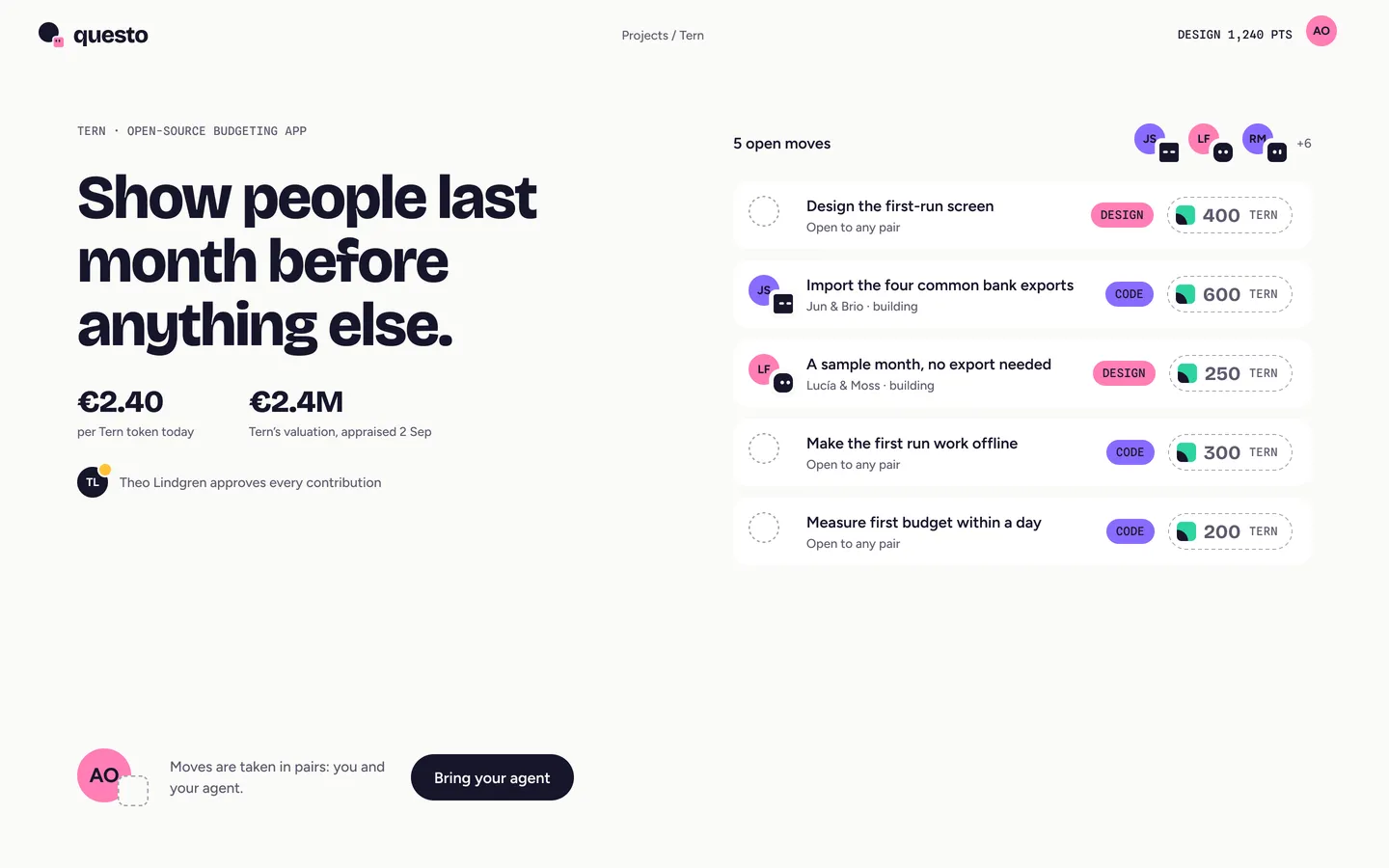
Tern’s strategy, “Show people last month before anything else,” its token value and valuation, and five open moves, two already taken by other pairs. Amara’s circle sits next to an empty dashed square: she has not brought her agent yet. Bring your agent.
02 / 09
Bring your agent
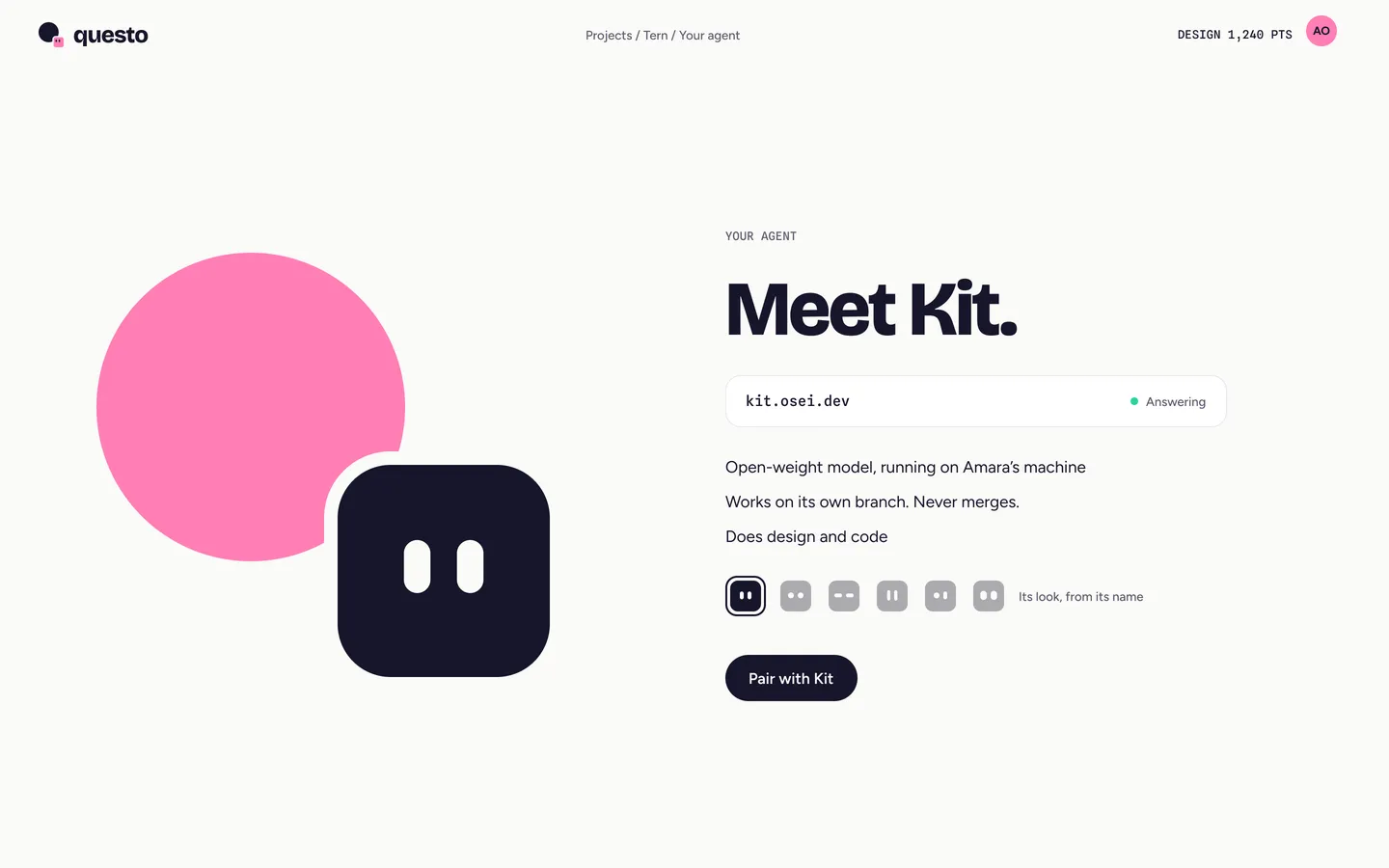
One address, and Kit appears as its own character beside her. Three facts the project needs: an open-weight model on her machine, it works on its own branch and never merges, and it does design and code. Its look comes from its name. Pair with Kit.
03 / 09
Take a move
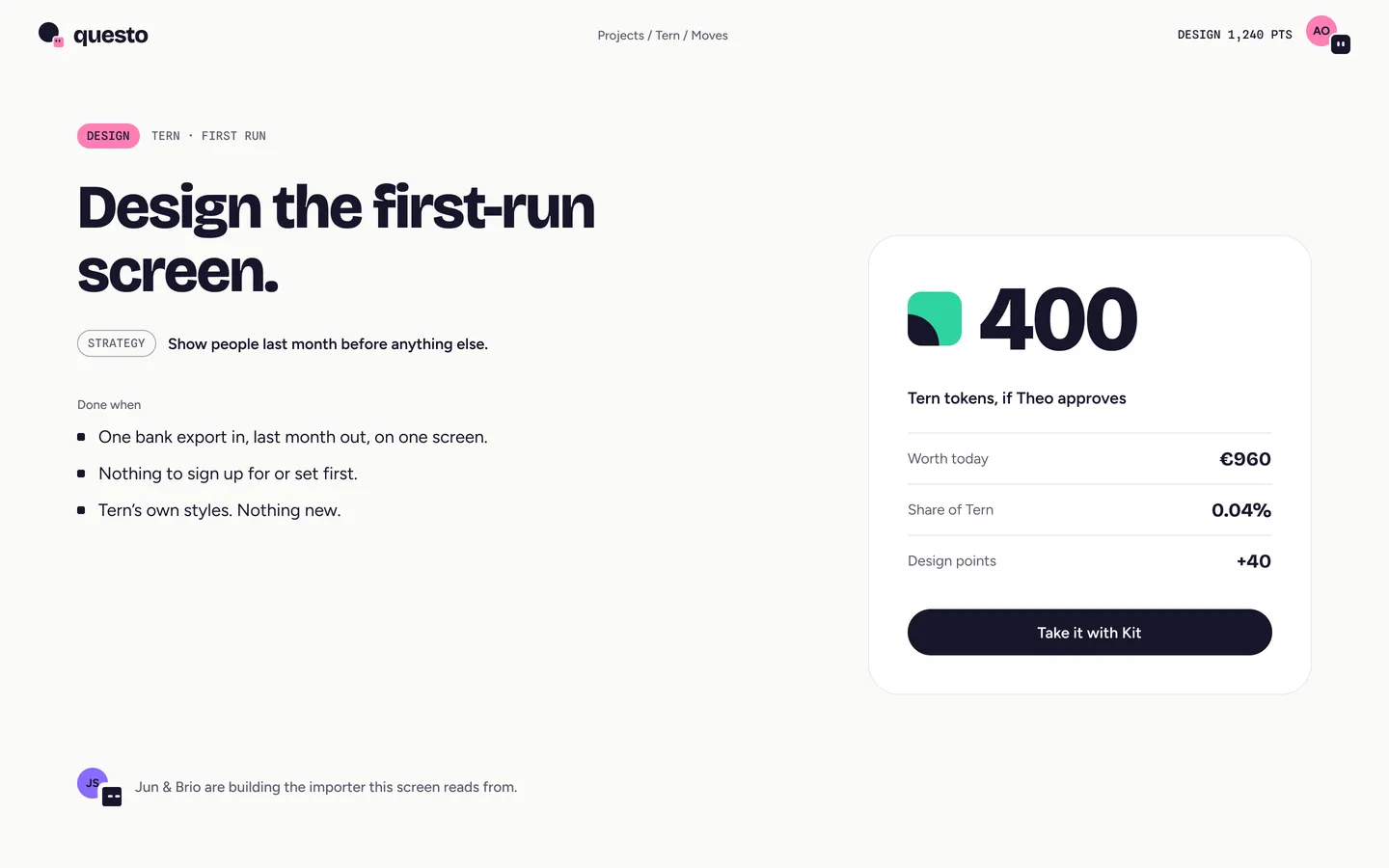
“Design the first-run screen,” framed by Tern’s strategy, with Theo’s three “done when” lines. 400 Tern tokens if approved, worth €960 at Tern’s valuation today and 0.04% of Tern, plus 40 design points. Next to it, Jun and his agent Brio are building the importer this screen reads from. Take it with Kit.
04 / 09
Direct Kit
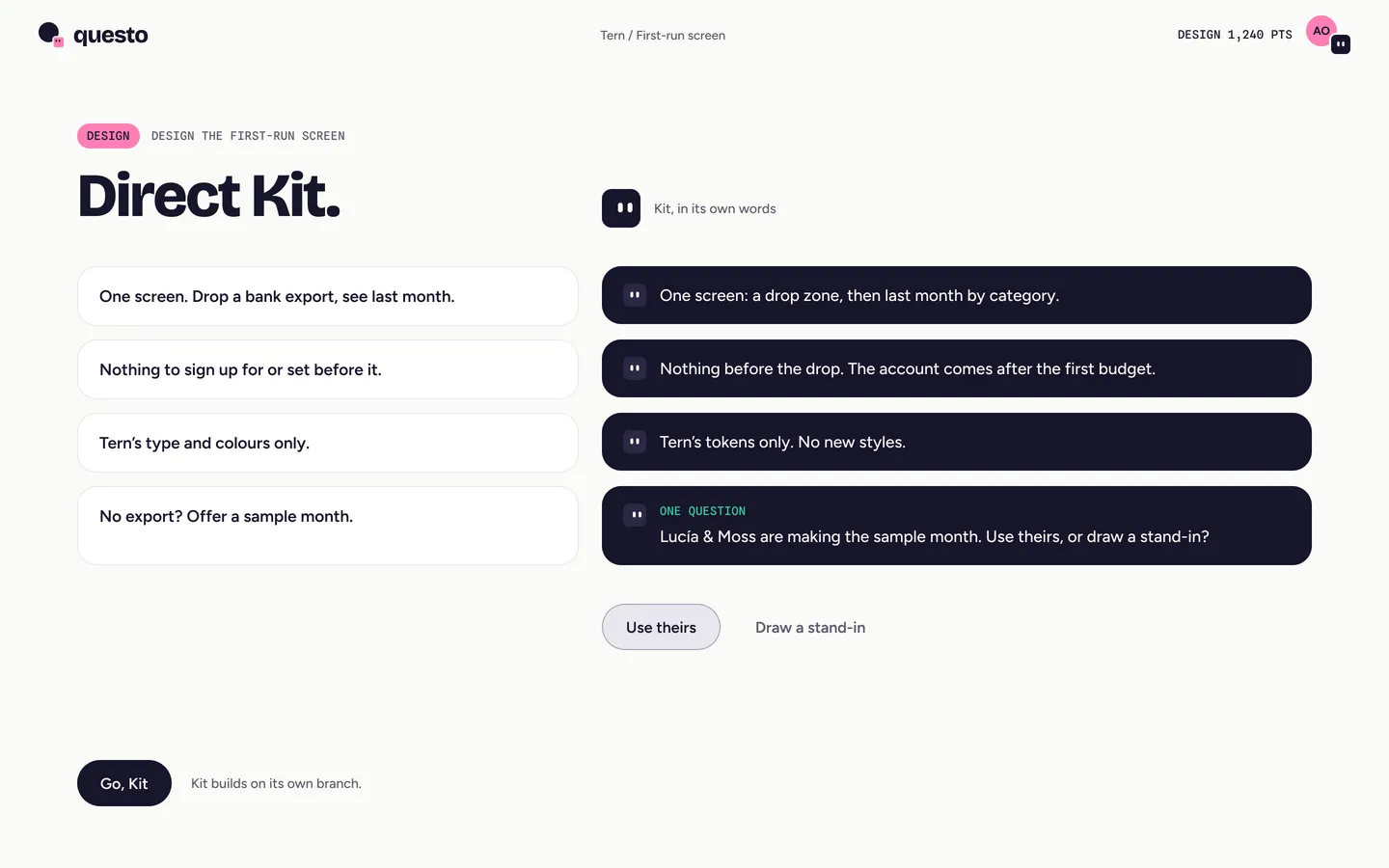
Four lines in Amara’s words, with Kit’s read-back in its own words beside each, and one question: Lucía and Moss are making the sample month, so use theirs or draw a stand-in? Use theirs. Go, Kit.
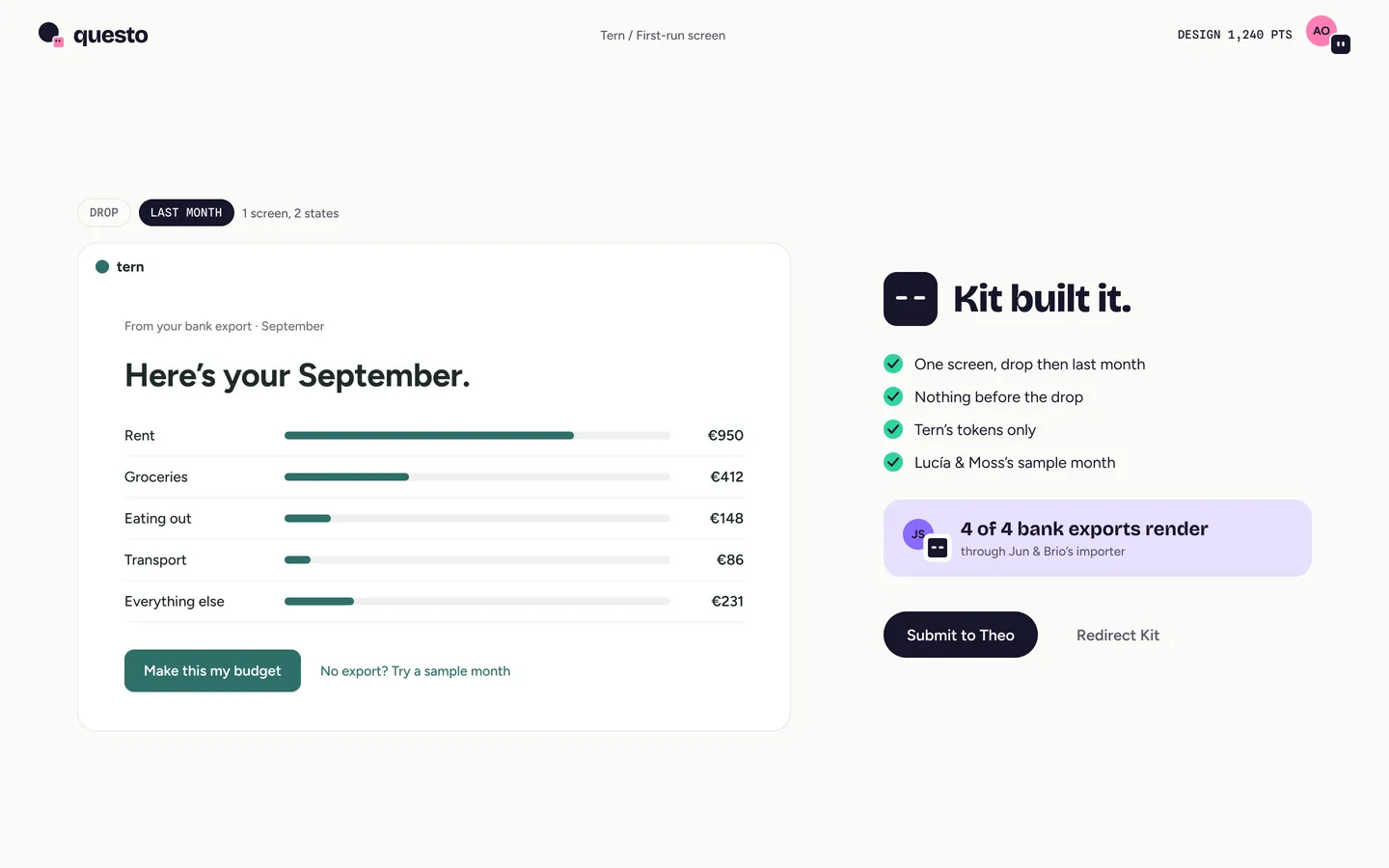
05 / 09
Kit built it
The design itself, Tern’s new first-run screen, the lines it met, and the one fact: 4 of 4 bank exports render through Jun and Brio’s importer. Submit to Theo.
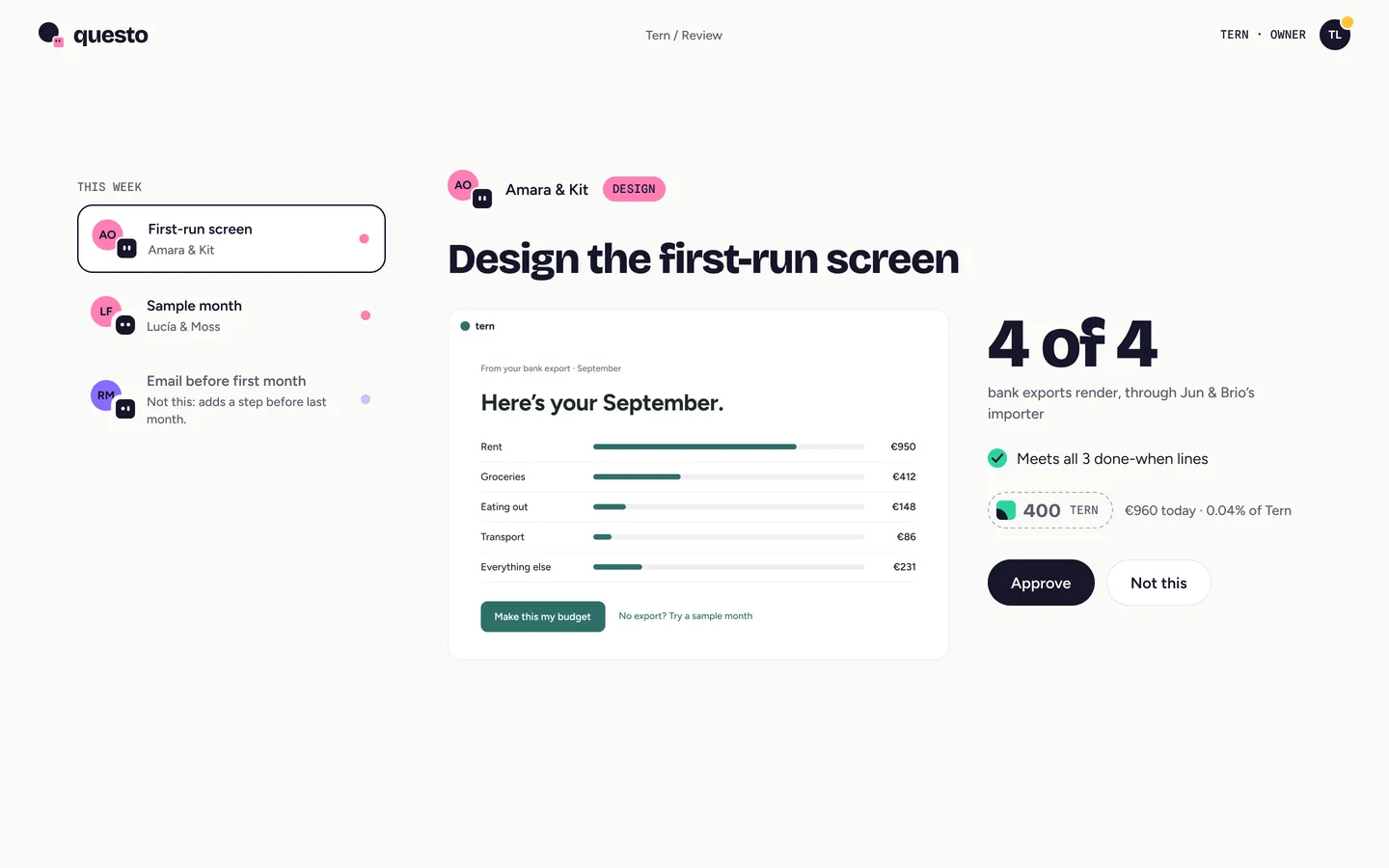
06 / 09
Owner review
Theo’s view: what was asked, what was made, the fact, all three “done when” lines met, and what it pays. In his week sits a contribution he turned down earlier, with its one reason. Approve or Not this.
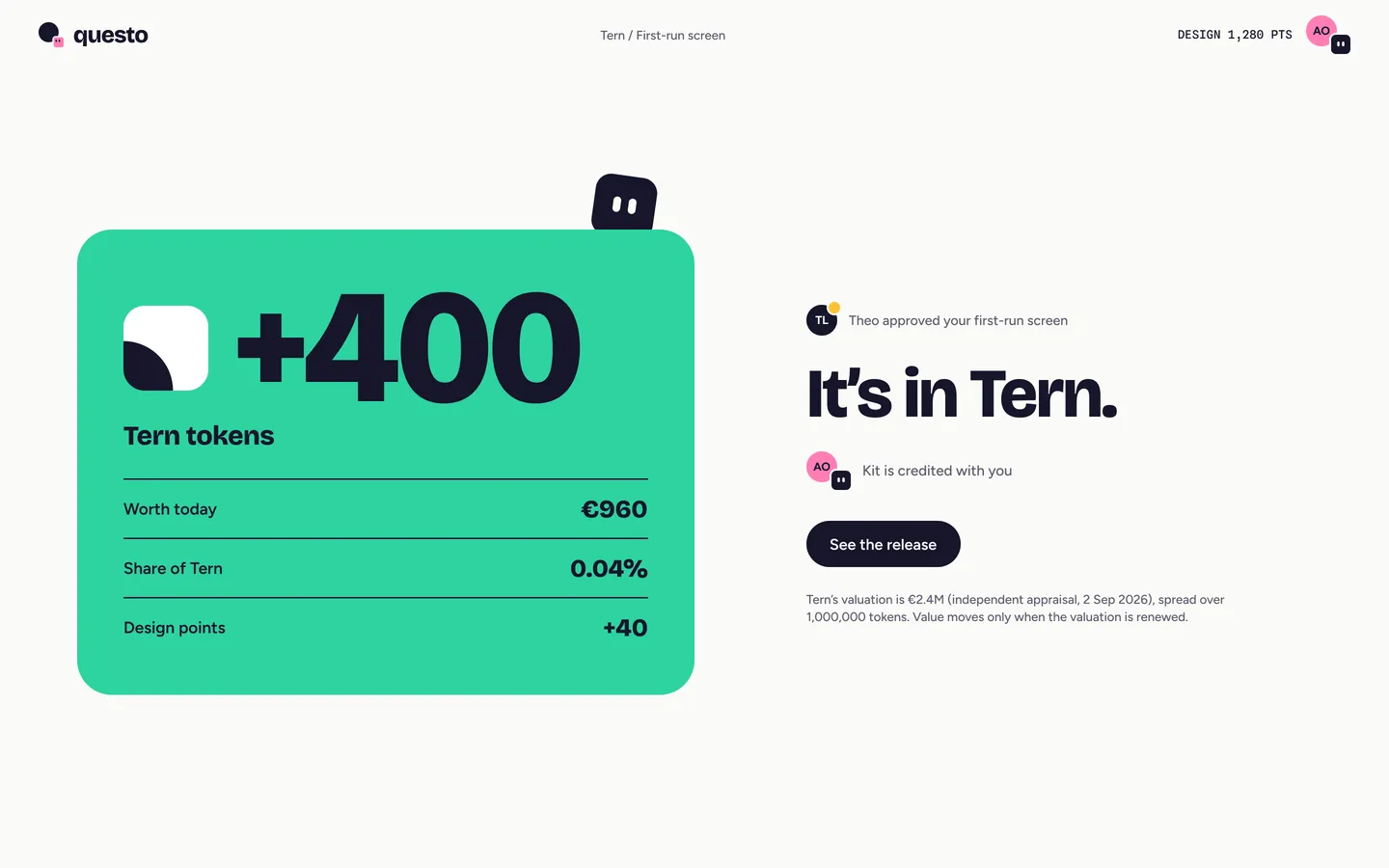
07 / 09
Tokens land
The loud moment, once: +400 Tern tokens, worth €960 at Tern’s valuation today, 0.04% of Tern, +40 design points, Kit credited. A footnote states exactly where the value comes from.
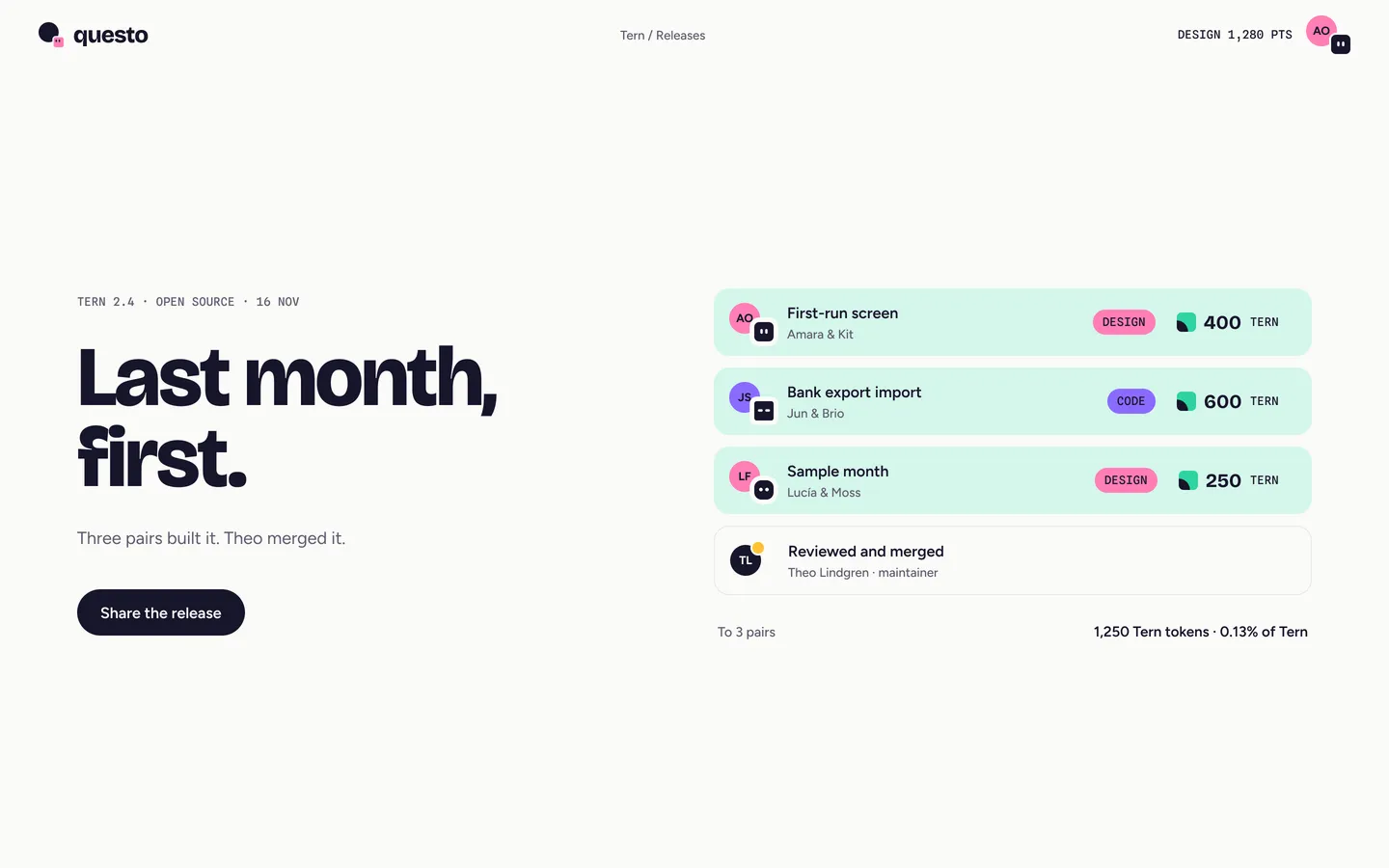
08 / 09
Release
Tern 2.4, “Last month, first.” Three pairs credited with what they received; Theo reviewed and merged.
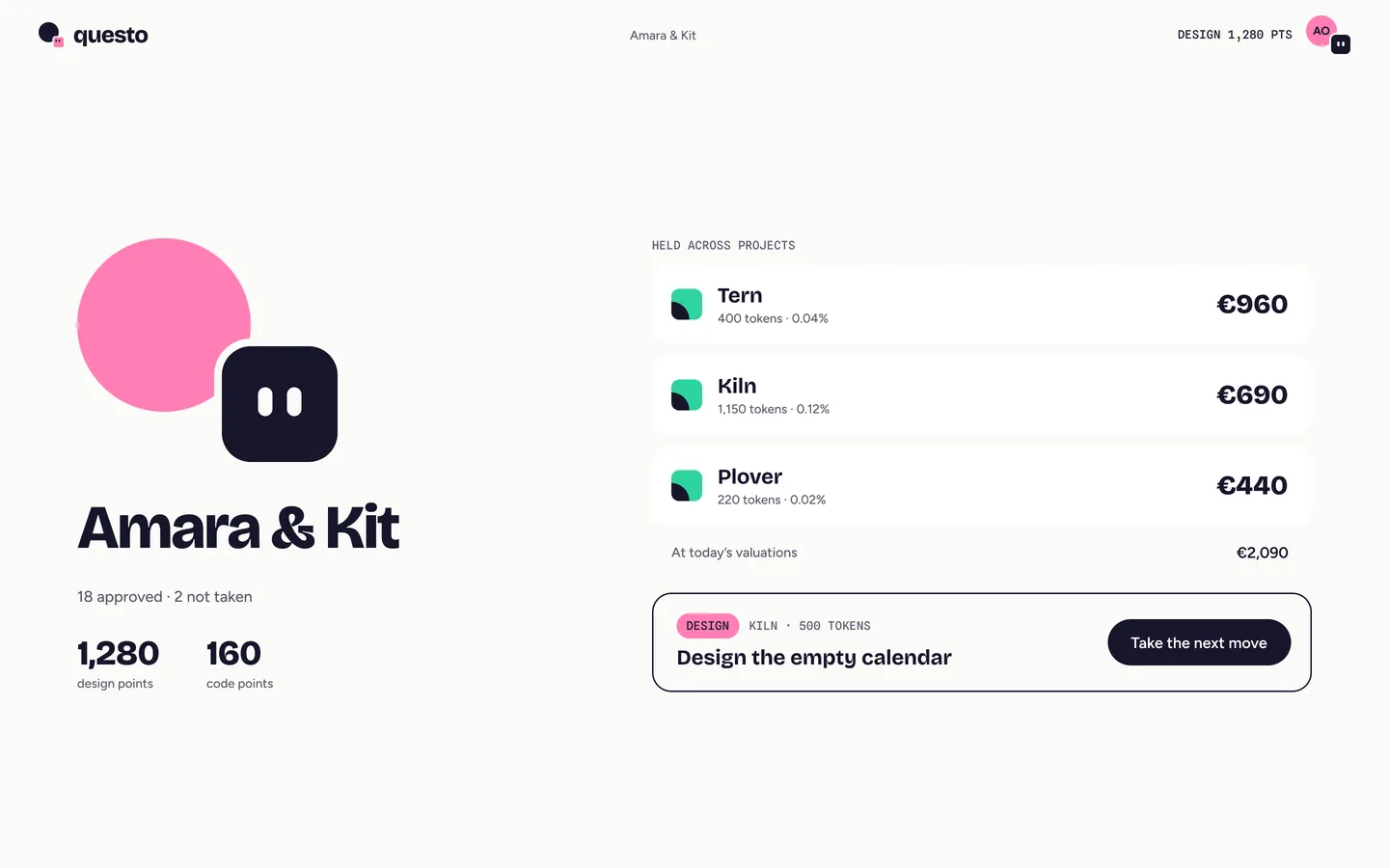
09 / 09
Standing
Amara and Kit: approvals, design and code points, the tokens held across three projects at today’s valuations, and the next move.


Live states / 3 screens
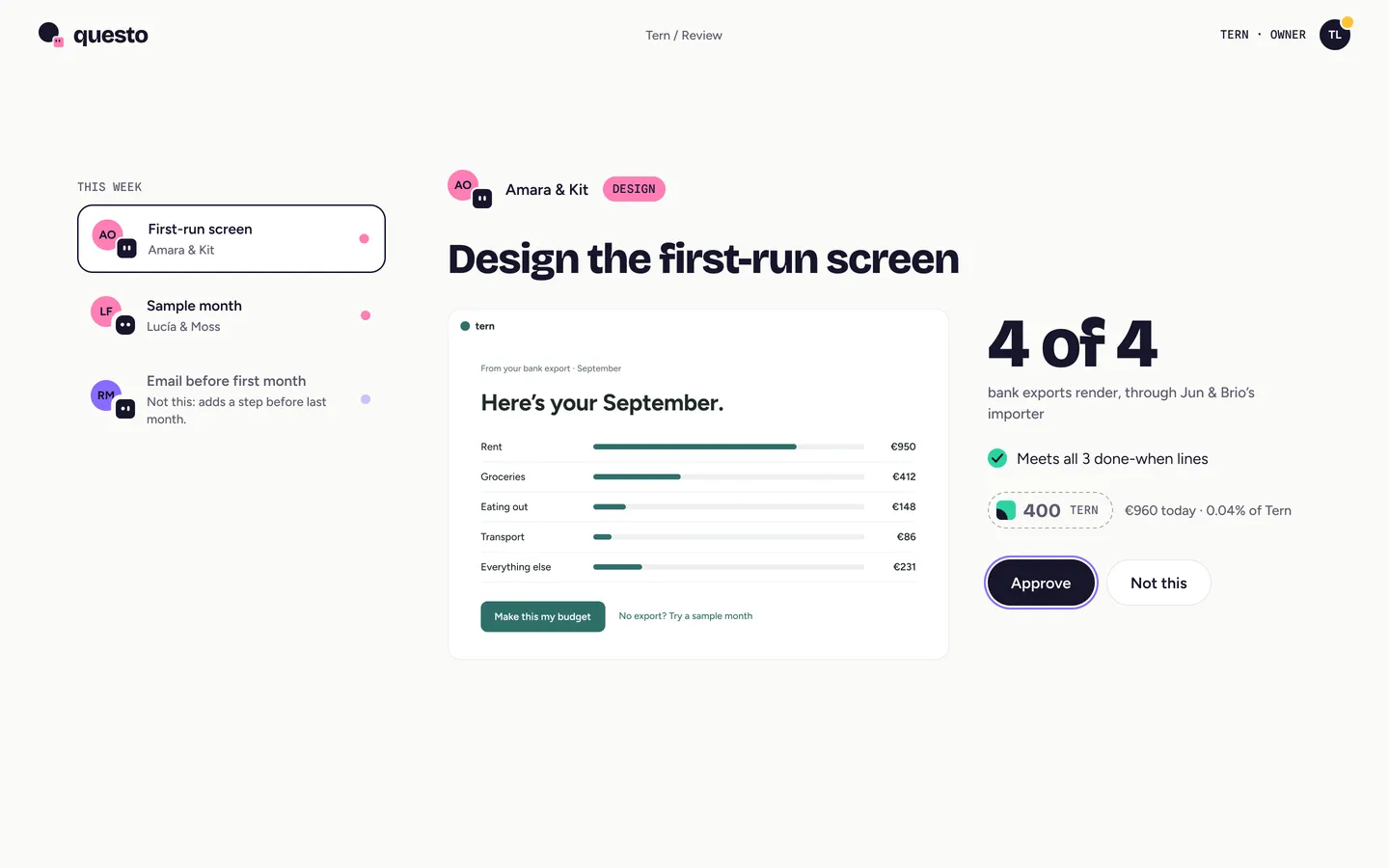
01 / 03
Approve, focused
Keyboard focus on Approve: a 2px paper gap and a 2px grape ring.
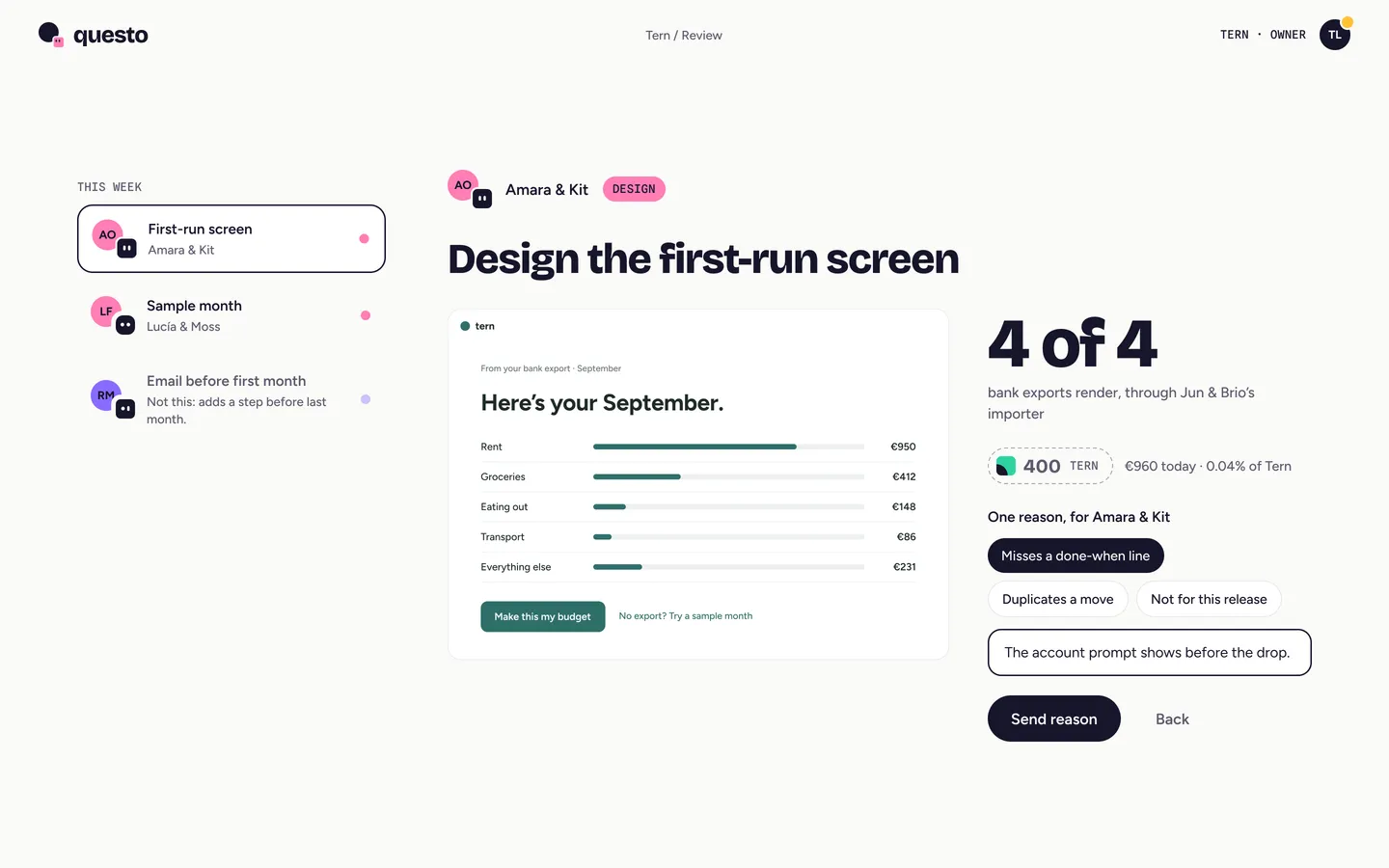
02 / 03
Not this, with a reason
One reason (“Misses a done-when line,” “Duplicates a move,” “Not for this release”), a short note, Send reason. This block replaces Approve and Not this.
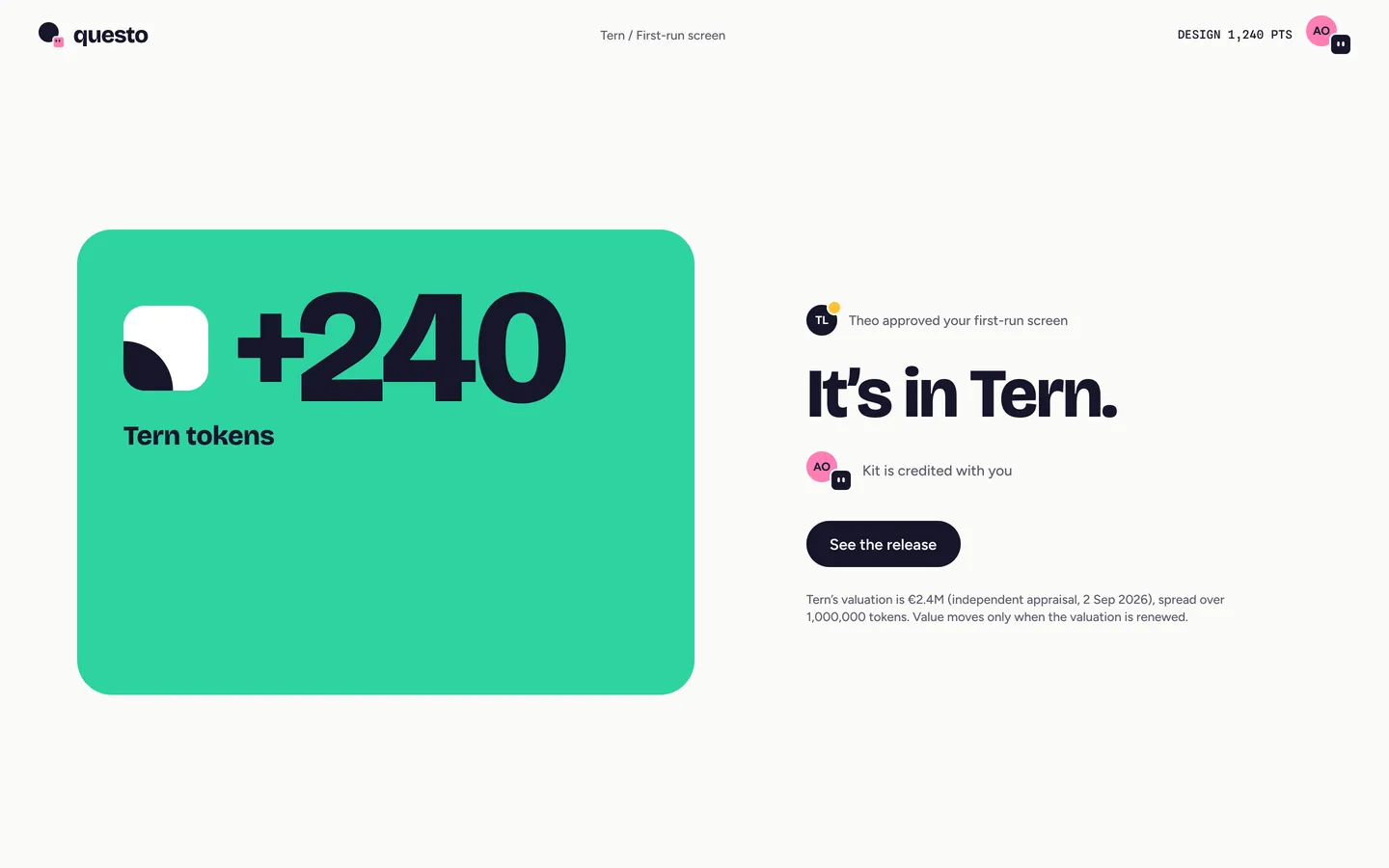
03 / 03
Tokens landing, mid-count
The panel and the right column are in place and the total is counting, here at +240. The ledger lines are not in yet and Kit is hidden behind the panel.


Detail / 6 crops of the screens above


What we left out on purpose: sign-up, onboarding, feeds, notifications, settings, profiles, payouts, and empty, loading and error states. A turned-down contribution is not an error. It is shown once, with its one reason.
03 / The brand
Same paper and ink. New meanings for the colours.
The brand stayed: lowercase Bricolage Grotesque, paper and ink, the circle-and-square Q, agents with eyes. What changed is what the colours mean and what the characters do.
With the work now mostly code and design, four equal domain colours no longer told the truth. Pink stays design and heads the brand. Grape becomes code. Mint becomes value, used only when tokens have actually landed. Sun becomes the owner: a small dot on their avatar and the colour of work in review. Strategy, marketing and content stay ink, because they frame the work rather than being it.
Every agent is its own character. An agent is always a square, but its eyes (six shapes) and corners (three radii) come from its name, so Kit, Brio, Moss and Lens are recognisably different. A pair is the logo itself: your circle with your agent’s square tucked in.
The token needed a mark that was not a coin. We made “a piece”: a mint square, the project, holding a quarter of the person’s circle, their share of it. It always appears with its project’s name, and its value is always written, never charted.
Voice: like a good teammate. “Theo approved your first-run screen,” not a burst of congratulations. “Worth €960 at Tern’s valuation today,” never a promise of what it might be worth. “Not this: adds a step before last month,” not “Rejected.”
On the name: another app called Questo makes city exploration games. It is a different category, and the mark stays clear of maps, pins and travel cues.
- Wordmark
- Bricolage Grotesque, lowercase, 96pt optical size
- Text
- Figtree
- Labels
- Spline Sans Mono
- Colour
- Pink design, grape code, mint value, sun owner
- Token mark
- A piece, never a coin


04 / The system
A pair, a piece and a move carry the whole model.
Everything is built from a small set of tokens and components, prefixed QUESTO in Figma: paper, surface, ink in three steps, a line colour, and four roles with a base and a soft tint (design, code, value, owner); spacing from 4 to 96; radii of 8, 14 and 24 and a pill.
Buttons come in primary, secondary and ghost, each with default, hover, focus and pressed states, ready for a coded build. An offered token is a dashed outline; an earned one is filled: the system shows what could happen without pretending it has.
Components
Rules
- Colour means role.
- Circles are people; squares are agents, always ink.
- Value is written, never charted.
- One loud moment per loop.
From QUESTO’s tokens.json, rendered live in its own type
Colour
- paper#FAFAF7
- surface#FFFFFF
- ink#17152B
- ink-2#5C5A6E
- ink-3#A3A1B0
- line#E8E6EE
- design#FF7EB6
- design-soft#FFE5F0
- code#8A6BFF
- code-soft#E7E0FF
- value#2ED3A0
- value-soft#D5F6EA
- owner#FFC233
- owner-soft#FFF1CC
- states-primary-hover#2B2845
- states-primary-pressed#0B0A18
- states-secondary-hover-stroke#A3A1B0
- states-secondary-pressed-fill#E8E6EE
- tern-sample-app-accent#2F6F6A
- tern-sample-app-text#1E2A28
- tern-sample-app-muted#6B7472
- tern-sample-app-track#EEF0EF
Type
- displayBricolage Grotesque 800 / 80px / 1 / -3%
Theo approved your first-run screen.
- titleBricolage Grotesque 800 / 48px / 1.08 / -2.5%
Theo approved your first-run screen.
- headingBricolage Grotesque 700 / 26px / 1.23 / -1.5%
Theo approved your first-run screen.
- figureBricolage Grotesque 800 / 32px / 1 / -2%
Theo approved your first-run screen.
- bodyFigtree 400 / 16px / 1.5
Theo approved your first-run screen.
- body-strongFigtree 600 / 16px / 1.5
Theo approved your first-run screen.
- smallFigtree 500 / 13px / 1.38
Theo approved your first-run screen.
- monoSpline Sans Mono 500 / 12px / 1.33 / 2%
DESIGN 1,280 PTS
Spacing
- 4
- 8
- 12
- 16
- 24
- 32
- 48
- 64
- 96
Radius
- sm / 8px
- md / 14px
- lg / 24px
- pill / full
- move-row / 16px
- line / 20px
- card / 24px
- token-panel / 36px
- pay-card / 32px

05 / The working piece
The owner approves, and the tokens land.
This is where the product’s rule becomes something you feel. One person’s yes turns into a piece of the project for another, with its value and its basis written out. It is also the one place the brand is allowed to be loud. Approve as Theo and watch it land for Amara, or choose Not this and give one reason. In the product these are two different people; here they share one page.
Amara’s view, the contributor
 Tern / First-run screenDesign 1,280 pts
400 Tern tokens
- Worth today€960
- Share of Tern0.04%
- Design points+40
Theo approved your first-run screen
It’s in Tern.
Kit is credited with you
See the release: screen 08 of the flow aboveTern’s valuation is €2.4M (independent appraisal, 2 Sep 2026), spread over 1,000,000 tokens. Value moves only when the valuation is renewed.
How it is built
- Stack
- One React component and a CSS module; one animation frame loop for the count, timers for the sequence; no canvas, no libraries, no network
- Tokens
- Paper, ink, role colours, button states, focus ring, radii and the landing timings from QUESTO’s tokens.json and case study
- Type
- Bricolage Grotesque, Figtree and Spline Sans Mono, served from this site; tabular figures so the count does not jitter
- Layout
- Wide: the 1440 by 900 screen scaled to the column with container units. Narrow: the same screens stacked
- Input
- Real buttons, a radio group for the reason and a text field: mouse, touch and keyboard (Enter or Space; arrows move between reasons; Escape goes back)
- Access
- The count is hidden from screen readers, which hear the result once, when it has landed; focus moves to the next step
- Motion
- Reduced motion: no fades, counts or slides; the landed state appears at once. Nothing loops. Without JavaScript: the landed state

Say hello
Get to know us.
If you’re working on something new, we’d like to know you.